
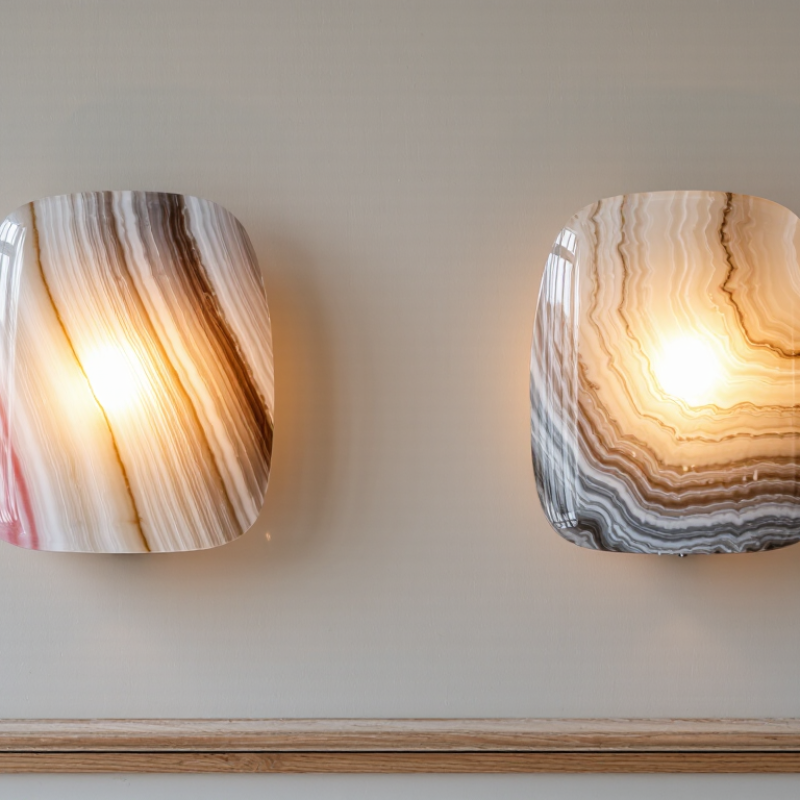
Alabaster Wall Sconces combine architectural lighting with the quiet character of natural stone. Their translucent bodies soften a bulb’s glare, creating a warm wash across plaster, wood, or painted walls. Veins may appear cream, honey, gray, or faintly rose-colored. No two shades look exactly alike.
This material choice also fits broader lighting priorities. The U.S. Department of Energy reports that LED lamps use at least 75% less energy than incandescent lamps and can last up to 25 times longer. That efficiency matters when sconces remain on through hallways, bedrooms, or restaurant evenings. The International Energy Agency has also identified lighting as a significant share of global electricity demand, reinforcing the value of efficient, well-controlled fixtures. These reports do not measure alabaster specifically. They do support a careful approach to the light source behind it.
Why choose Alabaster Wall Sconces? They add texture without demanding visual attention. A dimmed LED behind a hand-finished slab can resemble candlelight on a limestone wall. They suit refined interiors, but their appeal is not purely decorative. Alabaster can conceal harsh points of light and provide useful ambient illumination. Still, it is softer than glass and can show scratches, mineral variation, or installation marks. That limitation deserves honesty. Buyers should check stone thickness, LED heat management, mounting hardware, and cleaning instructions. A qualified electrician should verify the installation. The best choice balances beauty, durability, energy performance, and the room’s actual lighting needs.
What are alabaster wall sconces?
They are wall-mounted lights shaped around alabaster, a fine-grained form of gypsum stone. Natural gypsum alabaster typically measures about 1.5–2 on the Mohs hardness scale. That rating matters. A fingernail, metal edge, or rough cleaning pad can leave a mark. The stone is soft, not fragile by definition, but it needs deliberate handling. Its translucent body filters a bulb’s glow, creating warm shadows and visible mineral movement across the wall.
Tips: Choose a fixture with a stable mounting plate and accessible wiring. Use a qualified electrician for installation, especially on masonry or older walls. Keep the shade dry and dust it with a soft, clean cloth. In bathrooms, confirm the fixture’s moisture rating before purchase. Sealing may reduce staining, but it cannot make gypsum waterproof. I would not describe alabaster as maintenance-free.
Alabaster suits hallways, bedrooms, and dining areas where gentle illumination matters. When switched on, a thin stone shade can resemble a softly lit window. Each piece may show cloudy bands, small veins, or uneven translucency. These details are natural, not manufacturing defects. Still, the softness creates a practical compromise. Moving furniture too close may cause chips or scratches. Careful placement protects the surface and preserves its quiet, mineral character.
What Are Alabaster Wall Sconces and Why Choose Them?
Alabaster wall sconces combine sculptural stone with soft, practical illumination. Their translucent stone shades filter light instead of exposing a harsh bulb. Each piece has different veining, cloudiness, and color depth. That variation makes every fixture feel more personal, though it can also create uneven brightness between sconces.
A color temperature between 2700 K and 3000 K produces a warm, candle-like atmosphere. It works well in bedrooms, dining areas, hallways, and quiet hospitality spaces. Lower temperatures feel softer and more intimate. Around 3000 K appears slightly cleaner while remaining comfortable. Pairing alabaster with LEDs rated at CRI 90 or higher helps reveal skin tones, wood grain, and artwork more naturally. High CRI does not automatically mean perfect color. Testing samples remains sensible. Some materials still look different under real walls and furnishings.
Tips: Use dimming when possible. Install sconces at eye level, but check the shade’s brightness from nearby seating. Warm white light can look too yellow beside cool daylight. A small sample test may prevent an expensive adjustment. Clean alabaster gently with a dry, soft cloth. Moisture and strong cleaners may affect its surface. Expect subtle imperfections. They are part of the stone’s character, not always a flaw.
Alabaster naturally diffuses light through its translucent stone, creating a soft, warm glow. The recommended lighting specifications shown here are a color temperature of 2700–3000 K and a color rendering index of at least 90.
The chart presents the lower and upper limits of the warm-white color-temperature range alongside the minimum CRI requirement. A higher CRI helps colors appear more natural under the light.
What Are Alabaster Wall Sconces and Why Choose Them?
Alabaster wall sconces use a natural stone that filters light instead of simply reflecting it. Its translucent body creates a warm, candle-like glow across nearby walls. The effect feels calm, especially in bedrooms, hallways, and quiet dining areas. Not harsh. Not overly bright.
Each stone panel has different veining, from cloudy white ribbons to subtle amber lines. These markings form naturally, so no two sconces look completely identical. In practice, this variation can make a room feel more personal and less manufactured. However, the stone may not match perfectly in a pair. That small inconsistency deserves attention before installation.
The soft glare is another practical advantage. Alabaster diffuses the bulb’s intensity, reducing sharp reflections around eye level. A warm LED bulb usually supports this gentle appearance without producing excessive heat. The fixture still needs suitable electrical components and careful mounting. A qualified electrician should inspect the wiring and wall support, particularly with heavier stone designs. Regular dusting with a soft, dry cloth helps preserve the surface. Avoid abrasive cleaners, as they may dull the finish. Alabaster is beautiful, but it is not indestructible. Its delicate character can be its weakness.
| Data Dimension | Key Information | Practical Significance |
|---|---|---|
| Material | Alabaster is a soft, fine-grained stone, commonly composed of gypsum or, in some varieties, fine-grained calcite. | Its smooth surface and stone character give wall sconces a refined, architectural appearance. |
| Natural Translucency | Many alabaster pieces allow light to pass partially through the stone, although translucency varies with thickness, density, color, and mineral structure. | The illuminated stone can create a warm, softly glowing focal point rather than a transparent glass-like effect. |
| Unique Veining | Natural bands, clouds, inclusions, and tonal variations make each stone panel visually distinct. | No two sconces are guaranteed to have identical patterns, adding an individually crafted look to an interior. |
| Soft Glare | The stone diffuses and moderates the light source, reducing the sharp visual contrast produced by an exposed bulb. | It is well suited to bedrooms, hallways, dining areas, and other spaces where calm ambient lighting is preferred. |
| Light Quality | The final appearance depends on the stone, shade thickness, bulb color temperature, and fixture design. | Warm-white LED bulbs generally emphasize alabaster’s creamy tones and produce a comfortable decorative glow. |
| Color Range | Common tones include white, cream, honey, beige, and soft gray, often with subtle shifts within one piece. | The neutral palette coordinates easily with contemporary, traditional, minimalist, and natural-material interiors. |
| Texture and Finish | Polished alabaster appears smoother and more reflective, while honed or satin finishes provide a softer, more muted surface. | The finish can be selected to balance decorative detail with the desired level of visual softness. |
| Recommended Bulb | An LED bulb is typically preferable because it produces less heat and uses less energy than incandescent lighting. | Lower heat exposure can help protect the stone and surrounding components while supporting energy-efficient operation. |
| Maintenance | Dust with a soft, dry cloth. Avoid abrasive cleaners, acidic products, and excessive moisture, especially on gypsum-based alabaster. | Gentle cleaning helps preserve the surface finish and prevents staining or scratching of this relatively soft material. |
| Durability Consideration | Alabaster is softer and more vulnerable to impact and scratching than many harder stones, such as granite. | It should be installed where it is protected from knocks, and the stone should be handled carefully during installation. |
| Best Applications | Decorative accent lighting, bedside lighting, corridor illumination, living rooms, restaurants, and hospitality interiors. | Its strongest benefit is atmospheric illumination rather than high-intensity task lighting. |
| Selection Checklist | Review stone thickness, translucency, veining direction, fixture dimensions, bulb compatibility, mounting method, and electrical requirements. | These factors determine the sconce’s brightness, pattern visibility, installation safety, and suitability for the intended room. |
Alabaster wall sconces combine a stone shade with a concealed light source. Their natural veining softens glare and creates a warm, layered effect on nearby walls. Each shade looks slightly different, which adds character but can complicate visual matching. In practice, a 2700–3000K LED usually suits bedrooms, hallways, and dining areas.
LED efficiency matters more than decorative appearance. The U.S. Department of Energy reports that LEDs use at least 75% less energy and last up to 25 times longer than incandescent lamps. Modern LED systems can also exceed 100 lumens per watt, according to the DOE’s Solid-State Lighting research reports.
For an alabaster sconce, 400–800 lumens often provides useful accent lighting without overpowering the stone’s glow. Too many lumens can flatten the atmosphere.
Dimming requires careful specification. Confirm that the LED driver supports the intended wall dimmer, because flicker or a narrow dimming range can appear after installation. A smooth range from 10% to 100% is desirable, though real performance depends on the driver and wiring.
IP44 protection, defined under IEC 60529, indicates protection from solid objects larger than 1 millimeter and splashing water from any direction. It does not make the fitting waterproof. That distinction is easy to overlook. For bathrooms, placement outside direct spray remains sensible, even with IP44 protection.
Alabaster wall sconces use translucent gypsum stone to soften light and reveal natural veining. Thickness controls this effect. A practical starting range is 10–15 millimeters, but each slab transmits light differently. Request a lit sample before approving the final cut. IES guidance emphasizes brightness distribution and glare control, not wattage alone. Use a warm, dimmable LED and leave ventilation around the lamp. The U.S. Department of Energy reports that LEDs use at least 75% less energy and last up to 25 times longer than incandescent lamps. Less heat helps, though it does not make alabaster heatproof.
Mount the sconce on a rigid backplate with anchors rated for the fixture’s full weight. Do not let screws press directly against the stone. A qualified electrician should check the junction box, wiring, and lamp clearance.
I once trusted appearance alone. That was careless.
Clean alabaster with a dry microfiber cloth, then use a barely damp cloth for marks. Avoid vinegar, bleach, abrasive powder, and soaking. Keep water away. Natural alabaster can absorb moisture and stain. The U.S. Environmental Protection Agency recommends indoor relative humidity between 30% and 50% for moisture control, while ASHRAE Standard 160 provides a framework for evaluating building moisture conditions. Avoid bathrooms, outdoor walls, and locations exposed to steam or splashing. If moisture is unavoidable, reconsider the material. That choice is often overlooked.
They are wall lights with natural stone shades. The stone filters light, creating a warm, candle-like glow.
Alabaster diffuses light through its body. This creates softer glare and fewer sharp reflections near eye level.
Probably not. Natural veining varies from cloudy white ribbons to faint amber lines, even within one pair.
They suit bedrooms, hallways, and quiet dining areas. Their gentle light feels calmer than strong overhead lighting.
A 2700–3000K LED usually creates a comfortable warm tone. Around 400–800 lumens often suits accent lighting.
Yes, if the LED driver supports the selected wall dimmer. Check compatibility before installation to reduce flicker and limited dimming.
IP44 resists solid objects larger than one millimeter and splashing water from any direction. It is not waterproof.
Use a soft, dry cloth for dust. Avoid abrasive cleaners, and ask a qualified electrician to check wiring and wall support.
Its beauty comes with fragility. Matching may be imperfect, stone can break, and excessive brightness may weaken the atmosphere.
Alabaster Wall Sconces are decorative lighting fixtures made with natural alabaster, a form of gypsum stone rated approximately 1.5–2 on the Mohs hardness scale. Their semi-translucent material allows light to pass through softly, creating a warm, calming atmosphere. With a color temperature around 2700–3000 K and a CRI of 90 or higher, they can provide comfortable illumination while presenting colors more naturally. Each piece may feature distinctive veining, making every fixture visually unique and helping reduce harsh glare.
When selecting Alabaster Wall Sconces, consider efficient LED performance, suitable lumen output, and dimming compatibility for flexible control. An IP44 rating can offer protection against splashing water in appropriate indoor areas, although alabaster still has moisture limits and should not be exposed to prolonged dampness. Choose a suitable stone thickness and secure mounting method, then clean the surface gently with a soft, dry or slightly damp cloth. Avoid abrasive cleaners, soaking, and sudden temperature changes to preserve the stone’s appearance and structural integrity.