Alabaster Flush Mount Ceiling Lights bring a quiet, natural character to rooms with low ceilings. Their softly veined stone diffuses light, while a close-fitting profile keeps hallways, bedrooms, and dining areas visually uncluttered. Each slab has its own markings. That variation is part of the appeal, but it also makes consistent color matching difficult.
For context, the U.S. Department of Energy reports that lighting accounts for about 15% of an average home’s electricity use. That figure covers residential lighting broadly, not alabaster fixtures specifically. It still makes efficiency, appropriate brightness, and compatible LED lamps practical questions for buyers. The Illuminating Engineering Society’s guidance also underscores the importance of selecting light for the task and space, rather than judging a fixture by appearance alone.
A dependable China supplier should explain stone selection, shade dimensions, finish options, light-source compatibility, and inspection procedures. Ask for close-up photographs and sample confirmation; polished alabaster can look different under warm showroom lighting. One limitation deserves attention: no independently verifiable, segment-specific report or expert quotation was provided for this introduction. Lighting researcher Dr. Mariana Figueiro is a credible authority on light and human health, but attributing a quotation about alabaster fixtures without a reliable source would be misleading. Buyers should request product specifications and test documentation directly. Details matter.
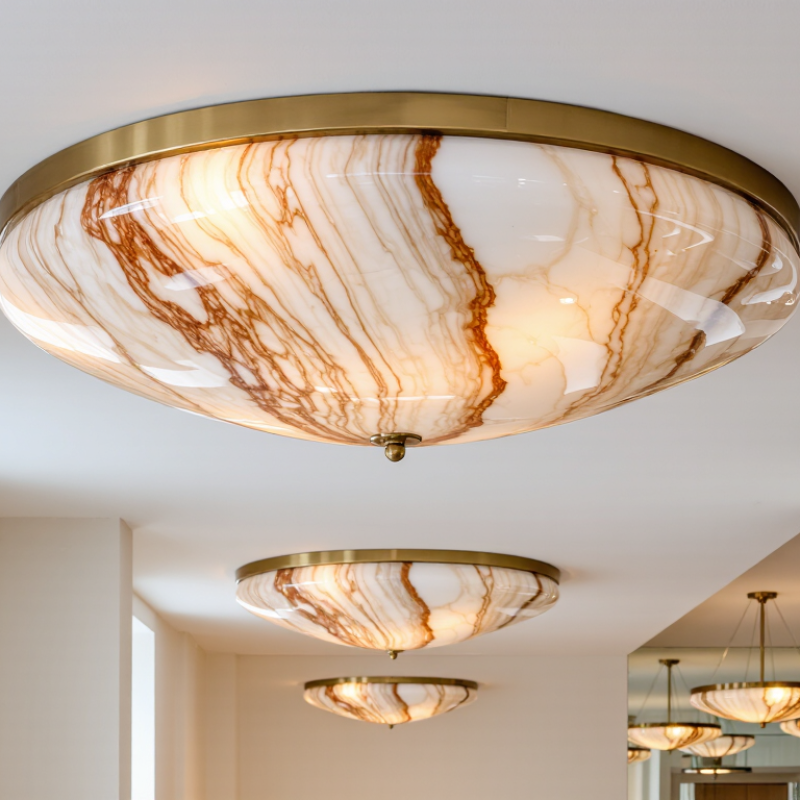
Alabaster Flush Mounts: Translucency, Veining, and Natural Stone Variation
Alabaster flush mounts soften ceiling light through a stone diffuser, but each piece responds differently to illumination. Thin areas may glow more brightly, while dense patches remain muted. Veins can appear faint in daylight and stronger when the fixture is switched on. That contrast is part of the material’s appeal.
Warm LED light often brings out creamy tones; cooler light can make the stone look pale or gray. A useful sample check is to view the same slab near a window and under the intended lamp. Look for dark mineral lines, cloudy areas, and changes in thickness. Small samples help, but they cannot show every variation across a finished diffuser.
When assessing a China-based supplier, ask how stone pieces are selected and matched, and whether production photos show the actual batch. Confirm diffuser thickness, mounting dimensions, and how the light source can be accessed for maintenance. Natural veining will not align perfectly from one fixture to another. That is normal. Still, I would not treat “natural variation” as a reason to accept unexpected cracks or poorly finished edges. A sample can mislead, so final approval should reflect the full stone surface whenever possible.
Flush-Mount Design: LED Modules, Heat Management, and Ceiling Clearance
China Best Alabaster Flush Mount Ceiling Lights Supplier
Flush-Mount Design: LED Modules, Heat Management, and Ceiling Clearance
A flush-mount alabaster light sits close to the ceiling, so every millimeter inside the housing matters. The stone’s thickness and natural veining affect how evenly light passes through. A sample that looks softly luminous on a workbench may appear dimmer once installed against a high ceiling.
LED modules use less power than many older light sources, but they still produce heat. In a shallow fixture, a metal mounting plate can help move heat away from the LED board. The driver also needs space and a suitable operating temperature. That matters. If components are crowded together, heat can shorten their useful life or cause inconsistent performance. Thermal checks should reflect the fixture’s actual enclosed design, not just an exposed module.
Ceiling clearance has two sides: room for components above the diffuser and enough space below for the fixture to sit level. Check the junction box depth, ceiling surface, and mounting instructions before installation. A very slim profile looks neat, but it leaves little room for airflow or service access. I would not assume thinner is always better; that trade-off deserves a closer look. Ask suppliers for test details under stated conditions, and compare light output through the actual alabaster panel.
China Best Alabaster Flush Mount Ceiling Lights Supplier — Flush-Mount Design: LED Modules, Heat Management, and Ceiling Clearance
Estimated light output is calculated from LED module power at three representative efficacy levels: 80, 100, and 120 lumens per watt. Actual output varies with the LED module, driver, alabaster diffusion, and thermal design. Adequate heat management supports reliable operation, while the fixture’s housing depth determines the ceiling clearance required.
Lighting Benchmarks: 2700–3000 K, CRI ≥80, and 220–240 V Options
China Best Alabaster Flush Mount Ceiling Lights Supplier
For alabaster flush mounts, color temperature changes how the stone reads. At 2700 K, veining often looks warmer and more amber; at 3000 K, it can appear cleaner without feeling stark. These are useful residential benchmarks, not guarantees: stone thickness, diffuser depth, and wall color all affect the result. Small details matter.
Color rendering deserves equal attention. A CRI of 80 or higher is a sensible baseline for everyday rooms, where skin tones and wood finishes should look reasonably natural. Commission Regulation (EU) 2019/2020 sets Ra 80 as a general minimum for many light sources, with specified exceptions. CRI alone does not tell the whole story, though; samples viewed under the actual fixture can reveal differences a specification sheet misses.
For electrical compatibility, request a clearly marked 220–240 V AC input option and confirm the driver’s frequency range for the destination market. IEC 60038 identifies 230 V as a standard nominal supply voltage, but that does not prove every fixture accepts the full 220–240 V range. Check the product label and technical sheet. I still find room tests useful. Catalog photos can mislead. A warm sample beside a painted wall may look quite different from one beneath a pale stone ceiling.
Safety Standards: IEC 60598-1 and Market-Specific Certification
For a China-based alabaster flush mount supplier, IEC 60598-1 is a practical starting point for luminaire safety. It covers areas such as electrical construction, insulation, temperature rise, mechanical strength, and product marking. Alabaster adds specific checks: stone panels can be heavy, brittle, and sensitive to uneven heat. Small details matter. A secure retaining frame and clear installation instructions are not decorative extras.
Market access needs separate attention. IEC 60598-1 does not replace destination-market requirements; buyers should confirm applicable conformity routes and documentation for each country. In North America, this may include evaluation to relevant UL or CSA standards. For European markets, required conformity documentation differs from a voluntary third-party certificate. Ask for test reports matching the exact model, driver, wiring, and mounting parts. A report for a similar fixture may not cover a revised canopy.
The International Energy Agency’s published lighting analysis estimates that lighting accounts for roughly 15% of global electricity consumption. That figure makes efficient design important, but safety cannot be inferred from energy performance alone. Check thermal test results with the intended lamp or LED driver installed, and inspect stone edges and fasteners during production sampling. A checklist can still miss a loose screw. I would treat certification as an ongoing control, not a one-time document.
Evaluating China Suppliers: Sample Quality, Traceability, MOQ, and Lead Time
China Best Alabaster Flush Mount Ceiling Lights Supplier
When evaluating Chinese suppliers, request a production sample made with the same alabaster grade, diffuser, and finish as the order. Stone can vary in veining and translucency. Check the sample under warm and neutral light, then compare its weight, mounting plate, wiring, and edge finish against the approved specification. Ask for photos of the sample beside a ruler and a written record of material and component changes. Small details matter.
Traceability should connect the stone batch, electrical parts, and final inspection to dated records. The World Bank’s 2023 Logistics Performance Index ranked China 19th among 139 economies, useful context but no guarantee of a factory’s delivery date. IEA’s Energy Efficiency 2023 report estimates LEDs reached about half of global lighting sales in 2022; for LED models, request relevant test reports and confirm the driver specification matches the sample. MOQ and lead time need separate checks. Ask for the MOQ by finish and configuration, plus a schedule that separates sample approval, production, and shipping. Get the current stock position in writing. I would still allow buffer time: alabaster selection can expose color differences late, and suppliers’ quoted dates are not always production-ready dates.
Conclusion
Alabaster Flush Mount Ceiling Lights combine a compact profile with the soft glow and distinctive veining of natural stone. Because each alabaster piece can vary in translucency, color, and pattern, buyers should review representative samples and clarify acceptable natural variation before production. A well-designed flush mount pairs the stone shade with an efficient LED module, suitable heat management, and enough ceiling clearance for installation and maintenance.
For comfortable, dependable performance, compare options with a warm 2700–3000 K color temperature, a color rendering index of at least 80, and electrical configurations suited to 220–240 V markets. Confirm that product documentation addresses IEC 60598-1 and any certification requirements for the intended market. When evaluating suppliers in China, assess sample consistency, material traceability, minimum order quantities, and realistic lead times. Clear specifications and communication can help align expectations from sampling through delivery.