
Choosing Handcrafted Brass Wall Sconces in 2026 requires more than matching a finish to your wall color. The right fixture should combine authentic craftsmanship, dependable performance, and a proportion that feels intentional. In my experience reviewing residential lighting, small details often reveal quality. Look closely at solder lines, mounting plates, socket alignment, and the consistency of the brass surface. A warm brushed finish may show subtle variation, while unlacquered brass can darken beautifully over time.
Lighting designer and author Randall Whitehead describes lighting as “the jewelry of architecture.” That idea remains useful when selecting Handcrafted Brass Wall Sconces. These fixtures should support the room, not compete with every object nearby. Check the light distribution beside a mirror, reading chair, or hallway artwork. A narrow shade may create dramatic shadows, but it can feel harsh in daily use. A wider shade may provide comfort, yet appear oversized on a slim wall.
Do not trust appearance alone.
In 2026, examine LED compatibility, dimming performance, color temperature, heat management, and replacement options. Verify whether the maker provides clear installation instructions and reliable warranty support. Responsible sourcing also matters, especially when the product claims recycled brass or small-batch production. Ask for material details and finish samples before ordering.
Some imperfections deserve attention. Handmade symmetry may not be exact, and that can add character. However, uneven arms, rough edges, or unstable wiring should not be romanticized. Measure twice. Consider viewing height, switch access, and future maintenance. A beautiful sconce is only successful when it remains safe, comfortable, and convincing after the room becomes part of everyday life.
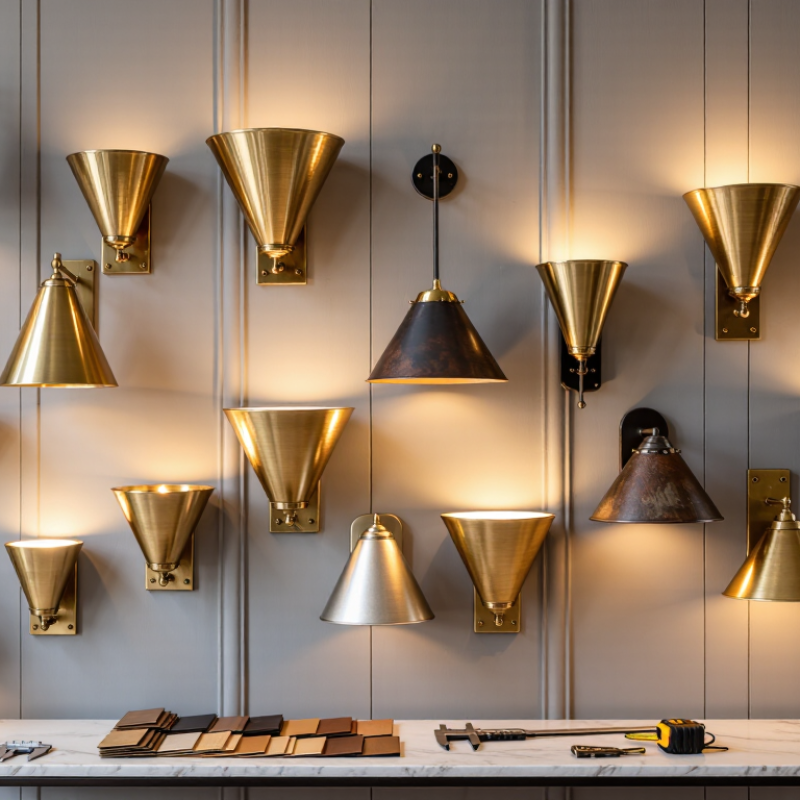
In 2026, handcrafted brass wall sconces should support the room’s entire lighting plan. Start by examining the brass finish under daylight and warm evening bulbs. Satin brass softens a hallway, while aged brass adds visual weight to plaster or dark wood. Polished brass reflects more light, but it can reveal fingerprints and uneven wall surfaces. I once chose a dramatic finish for a narrow entry. It looked beautiful in the showroom, then felt too bright at home.
Scale matters more than many buyers expect. Measure the wall, nearby furniture, and eye level before ordering. A sconce beside a mirror should not overpower its frame. For a bedside installation, check the shade position while sitting, not standing. The light source should feel useful, not decorative only. Layer the room with ambient, task, and accent lighting. A dimmable fixture can soften shadows and reduce glare during evening use. Always confirm wiring requirements with a qualified electrician.
Tips: Place matching sconces symmetrically when framing artwork or mirrors. Use varied layers when the room already has strong architectural balance. Keep the finish consistent with nearby metal details, but avoid perfect matching everywhere. Handmade surfaces naturally vary. That variation is part of their character, though I sometimes find one irregular mark distracting. Check the fixture from several angles before installation. Placement is difficult to undo.
Calculate the room’s lighting load before choosing a handcrafted brass wall sconce. IES guidance commonly suggests 10–20 footcandles (fc) for ambient lighting and 30–50 fc for task areas. For a 120-square-foot room, 15 fc requires about 1,800 delivered lumens. A 20-square-foot reading area at 40 fc needs approximately 800 delivered lumens. These figures describe useful light, not only the lamp’s advertised output.
Check the sconce’s distribution, mounting height, and shade design. A deep brass shade may create attractive contrast but reduce light reaching the wall or floor. Account for fixture efficiency, room reflectance, and future lumen depreciation. In practice, I often add a 20–30% planning margin because dark paint and textured surfaces absorb more light. My first estimates are sometimes too optimistic. Verify photometric data when available, then test one fixture at night before ordering several.
Tips: Use dimmable LED lamps with a warm color temperature, usually 2700–3000K, for comfortable brass illumination. Place task sconces near eye level, but avoid direct glare in mirrors or polished metal. Keep the calculation visible on paper. It makes revisions easier.
When choosing handcrafted brass wall sconces in 2026, begin with light quality, not only the metal finish. For living rooms, bedrooms, and reading corners, select 2700–3000 K. This range creates a warm glow without making skin tones look dull. It also complements brass, wood, linen, and muted wall colors. I usually test a sconce beside the actual furniture. Online images can mislead.
Choose a color rendering index of 90 or higher, especially near mirrors, artwork, and dining areas. High CRI helps reds, greens, and natural skin tones appear more accurately. Check the technical sheet, not just the product description. Some fixtures list a high CRI at one setting only. That detail deserves attention. A dimmable model can improve comfort, but the dimmer and lamp must be compatible. Flicker is unpleasant.
I once selected a 3000 K lamp for a small bedroom, expecting a clean, elegant effect. It felt slightly cold against pale brass after sunset. I would now test 2700 K first. Still, 2700 K may look too yellow beside cool daylight or blue-gray walls. Request a sample, if possible, and observe it morning and evening. Handcrafted surfaces vary, so reflected light may change subtly across each sconce. That variation is beautiful, but not always predictable.
Choosing handcrafted brass wall sconces in 2026 starts with an audit, not a polished photograph. Request the exact brass alloy, not simply “solid brass.” A material statement should identify composition and any steel components. Compare the stated alloy with a sample’s weight, machining marks, and magnet response. A magnet is only a clue. It cannot prove purity. Ask for independent test records when the specification seems vague.
Finish thickness deserves measured evidence. Ask whether the surface is lacquered, plated, or chemically treated. Request thickness data in microns, test method, and acceptable variation. On a hidden edge, inspect color consistency, sharp corners, and exposed threads. A handheld coating gauge may help, although curved fixtures can produce unreliable readings. That limitation matters. Do not treat one attractive sample as production proof.
Warranty documents reveal more than sales language. Check coverage length, electrical parts, finish wear, installation errors, and replacement procedures. Confirm who handles claims and which records are required. Keep invoices, specification sheets, and installation photos. A clear warranty builds trust; vague promises do not. I would still question unusually generous coverage. It may hide exclusions in fine print.
The chart shows published copper-content ranges for three commonly specified brass alloys. C26000 is typically a high-copper cartridge brass, C36000 is a free-cutting brass with added lead, and C46400 is naval brass containing copper, zinc, and tin. Use the alloy designation and a material certificate to confirm what is actually used in the sconce.
Finish thickness and warranty length do not have one universal requirement for every wall sconce. Ask for the measured coating thickness in micrometres, the test method, corrosion or adhesion test results, and a written warranty stating coverage, duration, exclusions, and remedy.
Alloy ranges shown are based on published ASTM composition specifications for C26000, C36000, and C46400 brass. The chart is an audit reference, not a product ranking.
When choosing handcrafted brass wall sconces in 2026, inspect safety before admiring the finish. UL 1598 covers construction and performance requirements for fixed electric luminaires. Ask for test documentation, not only a printed approval mark. Check wire insulation, strain relief, grounding, mounting hardware, and heat clearance around the brass body. A beautiful sconce can still conceal weak terminals.
It can happen.
For damp rooms, read the IEC 60529 IP rating carefully. IP44 protects against water splashes, while IP65 provides stronger dust protection and water-jet resistance. The rating does not automatically approve a fixture for every bathroom zone. Installation rules still depend on local electrical codes. Confirm the intended location with a qualified electrician. Hand-finished surfaces also deserve inspection; uneven lacquer may age faster near steam.
LED efficiency should be measured, not assumed. The U.S. Department of Energy reports that LEDs use at least 75% less energy than incandescent lighting and can last up to 25 times longer. The IEA has also identified lighting efficiency as a major electricity-saving opportunity worldwide. Compare lumens, watts, color temperature, dimming compatibility, and claimed lifetime. A 6-watt LED producing 500 lumens may suit a bedside wall, but not a reading chair. I sometimes trust warm brass too quickly. That is a mistake worth correcting. Ask for replacement-driver access, flicker information, and a photometric report before purchase.
| Decision Dimension | What to Verify | Relevant Standard or Rating | Practical Selection Benchmark | Why It Matters |
|---|---|---|---|---|
| Safety listing | Look for a permanent product label, installation instructions, electrical ratings, and evidence that the complete luminaire—not only an individual component—was evaluated. | UL 1598 covers safety requirements for luminaires, including construction, wiring, grounding, thermal performance, and testing. | Choose a luminaire with documentation from a recognized testing or certification body and a rating suitable for the intended installation location. | A handcrafted appearance does not replace electrical evaluation. Listing information helps confirm safe installation and operating conditions. |
| Supply voltage and frequency | Confirm the luminaire’s input voltage and frequency match the building supply. Check whether a driver, transformer, or dimmer is required. | Use only the voltage and frequency printed on the product label and installation instructions. | For a 120 V installation, select a 120 V-rated model; for a 230 V installation, select a 220–240 V-rated model where permitted by the product documentation. | Incorrect voltage can cause overheating, flicker, premature failure, or an electric-shock hazard. |
| Grounding and wiring | Verify that the fixture has the required grounding arrangement, insulated wire connections, strain relief, and an accessible junction-box connection. | Follow the applicable local electrical code and the luminaire’s installation instructions. | A metal-bodied brass sconce should normally have an appropriate protective-earth connection unless it is specifically designed and marked as Class II/double-insulated. | Brass is electrically conductive. Correct grounding reduces shock risk if an internal fault energizes the metal body. |
| Ingress protection | Check the complete luminaire’s IP code, not merely the LED module or driver’s rating. | IEC 60529 defines IP ratings. The first digit addresses solid-particle protection; the second addresses water protection. | Use IP20 only in dry indoor areas; consider IP44 for locations exposed to splashing water; use higher ratings when the installation environment requires them. | The correct IP rating helps protect electrical parts from dust, accidental contact, humidity, and water exposure. |
| IP code reference | Match the rating to the actual location, including bathroom zones, covered outdoor areas, and locations exposed to hose spray. | IP20: protected against fingers or objects over 12.5 mm; no water protection. IP44: protected against solid objects over 1 mm and splashing water from any direction. IP65: dust-tight and protected against water jets. |
Do not treat IP44 as waterproof or IP65 as suitable for immersion. Follow local rules for wet-room installation zones. | IP numbers describe tested protection levels; they do not by themselves approve every installation location. |
| LED energy use | Compare actual wattage and delivered lumens rather than comparing wattage alone. | Energy use is calculated as watts × operating hours ÷ 1,000 = kWh. | An 8 W LED used for 3 hours per day consumes approximately 8.76 kWh per year. | Lower wattage can reduce electricity consumption while maintaining the required light output. |
| Illustrative LED savings | Use the actual electricity rate, daily operating hours, and lamp wattages for a project-specific result. | Example assumes one 60 W incandescent lamp replaced by one 8 W LED, operating 3 hours daily, 365 days annually. | Annual energy reduction: approximately 56.94 kWh. At $0.15/kWh, electricity-cost reduction is approximately $8.54 per fixture per year. | This is an illustrative calculation; actual savings vary with local utility prices, usage, controls, and replacement wattage. |
| Light output and color | Check delivered lumens, color temperature, color-rendering information, beam distribution, and whether the diffuser changes output. | Lumens measure visible light output; watts measure electrical power. They are not interchangeable. | For a warm residential appearance, 2700–3000 K is commonly selected; choose the lumen output based on room size and task needs. | Correct light quality supports comfort, visibility, and the intended appearance of the brass finish. |
| Dimming compatibility | Verify that the LED driver and wall control are compatible, and check the manufacturer’s minimum and maximum load requirements. | Use the dimmer type specified for the fixture, such as compatible phase-cut or electronic controls. | Select a fixture explicitly marked as dimmable if adjustable brightness is required. | Incompatible controls may cause flicker, buzzing, limited dimming range, or driver damage. |
| Brass construction and finish | Ask whether the visible brass is solid brass, brass sheet, or a brass-colored plated finish. Inspect seams, soldering, edges, mounting hardware, and finish consistency. | Material descriptions should be specific and supported by product documentation. | Prefer a clearly documented material specification and a care guide that explains polishing, lacquer protection, and moisture exposure. | Handcrafted variation can be attractive, but clear material information helps set expectations for patina, maintenance, and durability. |
| Thermal management | Check the maximum permitted lamp wattage, LED driver location, ventilation openings, and clearance from curtains or other combustible materials. | Use the temperature and installation limits provided with the listed luminaire. | Never exceed the stated wattage or enclose an LED lamp unless the lamp and fixture are both approved for enclosed use. | Excess heat can shorten LED and driver life and may create a fire risk. |
| Installation and maintenance | Confirm mounting dimensions, junction-box compatibility, included hardware, cleaning instructions, replacement parts, and access for servicing. | Installation should follow the product instructions and applicable local electrical requirements. | Have fixed-wiring work completed by a qualified electrician where required by local law. | Correct mounting and maintenance preserve safety, finish quality, and long-term performance. |
Note: Standards, electrical codes, wet-location requirements, and certification rules may vary by country or jurisdiction. Always use the product’s current installation documentation and local code requirements.
View the finish in daylight and under warm evening bulbs. Satin brass softens hallways. Aged brass suits plaster and dark wood. Polished brass reflects more light but shows fingerprints easily. I once chose a bright finish for a narrow entry. It looked better in the showroom.
Measure the wall, nearby furniture, and eye level before ordering. A sconce beside a mirror should not overpower its frame. Check the shade position while sitting beside a bed. Measure twice.
General lighting often needs 10–20 footcandles. Reading areas commonly need 30–50 footcandles. A 120-square-foot room at 15 footcandles needs about 1,800 delivered lumens. A 20-square-foot reading area at 40 footcandles needs about 800 lumens.
Consider adding a 20–30% planning margin. Dark paint and textured walls absorb more light. Fixture efficiency also reduces delivered brightness. My first estimates are sometimes too optimistic. Verify photometric data when available.
Combine ambient, task, and accent lighting. Use dimming to soften evening shadows and reduce glare. A deep brass shade can create contrast but may block light from walls or floors. Decorative light alone may feel attractive but insufficient.
Place task sconces near eye level. Check the light while seated, especially near beds or reading chairs. Avoid direct reflections in mirrors and polished metal. Placement is difficult to undo.
Request documentation for fixed-luminaire safety testing. Inspect wire insulation, grounding, strain relief, mounting hardware, and heat clearance. Confirm wiring requirements with a qualified electrician. A beautiful fixture can still hide weak terminals.
Check the IP rating carefully. IP44 resists water splashes. IP65 offers stronger dust protection and water-jet resistance. These ratings do not automatically approve every bathroom location. Local electrical rules still matter.
LEDs generally use much less energy than incandescent lamps. Compare lumens, watts, color temperature, dimming compatibility, and stated lifetime. Warm lamps around 2700–3000K usually create comfortable brass illumination. Ask about flicker and replacement-driver access.
Yes, handmade surfaces naturally vary. Uneven marks can add character, but one distracting flaw may bother you later. Inspect the fixture from several angles before installation. Not always easy.
Choosing Handcrafted Brass Wall Sconces in 2026 requires more than selecting an attractive finish. Start by matching the brass tone, fixture scale, and lighting layers to the room’s architecture and furnishings. Plan approximately 10–20 foot-candles for ambient illumination and 30–50 foot-candles for task areas, adjusting placement and quantity according to room use. For living spaces, warm 2700–3000 K light and a CRI of 90 or higher can create a comfortable atmosphere while preserving the appearance of materials and artwork.
Careful craftsmanship and safety checks are equally important. Ask for clear information about the brass alloy, finish thickness, corrosion resistance, and warranty coverage to assess long-term quality. Confirm that the fixture has appropriate safety certification, such as UL 1598 where applicable, and review IEC 60529 IP ratings if it will be installed in a damp location. Finally, compare LED efficiency, expected lifespan, dimming compatibility, and maintenance needs to achieve reliable performance, lower energy use, and a finish that remains beautiful over time.