
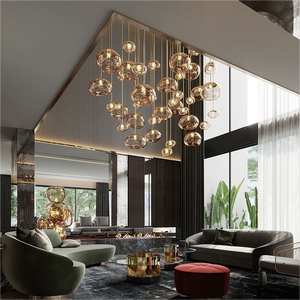
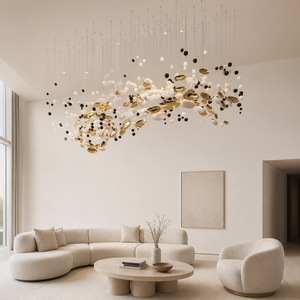
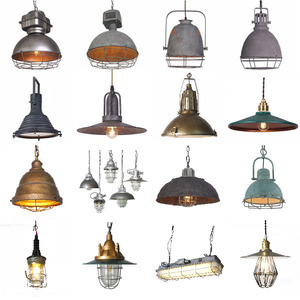
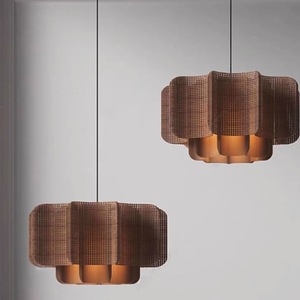
Explore our custom OEM/ODM production capabilities—from high-ceiling luxury chandeliers to hand-sculpted wabi-sabi pendants and solid brass lanterns.
In the contemporary landscape of international architectural design, commercial real estate development, and luxury hospitality procurement, lighting is no longer treated as a mere decorative afterthought. It is a critical engineering component that defines spatial ergonomics, brand prestige, operational energy efficiency, and long-term facility durability. Selecting a qualified OEM (Original Equipment Manufacturer) and ODM (Original Design Manufacturer) custom lighting manufacturer represents one of the most vital strategic decisions for architects, specifiers, and global lighting procurement directors.
Commercial specifiers face an increasingly volatile supply chain and stringent building codes. Standard catalogue luminaires frequently fail to meet non-standard ceiling drops, specific localized voltage requirements, strict photometric distributions, or harsh environmental conditions (such as coastal salt spray exposure). Partnering with a vertically integrated lighting manufacturer capable of taking a concept from initial CAD modeling and rapid prototyping through to UL 1598 wet-location certification is essential for risk mitigation and project success.
To optimize procurement workflows, specifiers must distinguish between OEM and ODM project scopes:
We refuse to compromise with plated zinc or stamped steel. All metal components are cast, extruded, or spun from heavy-gauge C26000 solid brass, bronze, and copper, ensuring structural integrity and lifetime corrosion resistance.
Unlike synthetic acrylic or resin imitations that yellow and degrade over time, our stone lighting uses authentic, natural Spanish Volterra alabaster, hand-carved to diffuse warm, organic, one-of-a-kind light patterns.
No forced catalog dimensions. Stems, overall drop lengths, backplate projections, shade diameters, and canopy mountings are engineered specifically to match your architectural sightlines and ceiling grids.
A primary factor contributing to early fixture failure in hospitality and exterior commercial environments is substrate corrosion and material degradation. As a premier custom lighting factory established with decades of heritage, our manufacturing philosophy centers on material purity and artisanal finishing processes.
Commercial fixtures installed in coastal hotels, open-air resort corridors, or high-humidity public spaces are subjected to continuous environmental oxidation. Cheap consumer-grade fixtures utilize die-cast zinc alloys (Zamak) or cold-rolled steel with thin electroplated coatings. Once the paper-thin micro-plate is scratched or weathered, moisture penetrates the iron core, causing rapid rust bleed, flaking finish, and eventual structural failure.
Our workshop utilizes heavy-wall C26000 cartridge brass and marine-grade bronze. Brass is an alloy of copper and zinc that inherently resists galvanic corrosion. When exposed to outdoor atmospheric moisture, solid brass forms a protective, non-flaking oxide film (patina) that self-passivates the metal underneath. For specifiers desiring dynamic, aging aesthetics, our unlacquered "living finishes" evolve gracefully over decades. For commercial projects requiring static color uniformity across 500+ rooms, we apply protective baked clear coats or PVD (Physical Vapor Deposition) coatings tested to withstand 1,000+ hours of ASTM B117 salt spray exposure.
Alabaster is a fine-grained, translucent stone form of gypsum prized since antiquity for lighting applications. In the modern marketplace, many suppliers substitute genuine stone with poured polyester resin or acrylic mixed with stone dust to reduce raw material costs.
The differences between genuine alabaster and synthetic resin are critical for lighting specifiers:
For procurement managers evaluating vendor bids, the short-term unit price must be balanced against total life-cycle cost, replacement frequency, installation labor, and risk of project delay. The table below details the operational differences:
| Engineering Parameter | Enterprise OEM/ODM Custom Factory | Standard Import Catalog Distributor |
|---|---|---|
| Structural Substrate | Solid C26000 Brass, Bronze, Copper, Natural Alabaster | Electroplated Zinc Alloy (Zamak), Thin Sheet Steel, Acrylic Resin |
| Dimensional Tailoring | Custom drop lengths, stems, and backplates to 1/16" accuracy | Fixed catalog dimensions; site cutting voids safety warranty |
| Photometric Control | Custom CCT (2200K-5000K), CRI 95+, Tunable White, Custom IES files | Fixed CCT (usually 3000K/4000K), low CRI (80), uncalibrated beam angles |
| Driver & Control Compatibility | 0-10V, DALI-2, Casambi Wireless, Phase-cut, Lutron Ecosystems | Basic non-dimmable or noisy low-cost TRIAC drivers |
| Compliance & Certification | UL 1598, CSA C22.2, CE, RoHS engineered to order per location | Generic batch certification; non-compliant with local building inspectors |
| Spare Parts & Longevity | 100% modular assemblies; replacement glass/parts available 10+ years | Discontinued inventory; full fixture replacement required upon failure |
Achieving flawless execution on large-scale custom lighting orders requires a disciplined, multi-stage engineering workflow. Here is how our factory translates complex architectural concepts into certified, site-ready luminaires:
Our engineering team reviews project elevation drawings, structural attachments, and electrical junction box locations. We generate parametric 3D CAD models and BIM objects, conducting Design for Manufacturing (DFM) checks to optimize thermal dissipation, structural load safety factors (5x static weight rating), and wiring pathways.
Prior to full batch casting or spinning, physical prototypes or 3D-printed mockups are assembled. Thermal testing is conducted using calibrated thermocouples to ensure LED junction temperatures stay well below maximum limits. Integrating sphere and goniophotometer testing generates accurate IES/LDT photometric data for lighting designers.
Raw brass plates, tubes, and castings undergo precision CNC milling, manual lathe spinning, silver soldering, and seam welding. Artisans apply chemical patination baths (oil-rubbed bronze, antique brass, satin nickel) by hand, followed by protective clear lacquer or wax application.
Fixtures are wired with high-temperature silicone lead wires and certified LED drivers. Every single unit undergoes a 100% Hi-Pot (High Voltage Dielectric Withstand) test, ground continuity verification, and a 4-hour continuous burn-in test before being packed in custom engineered foam crates.
As commercial real estate and hospitality design evolve toward hyper-personalized guest experiences and strict ESG (Environmental, Social, and Governance) targets, custom lighting procurement is undergoing several technological shifts:
Modern architectural lighting must seamlessly interface with modern Building Management Systems (BMS). OEM manufacturers must offer integrated wireless control nodes—such as Casambi, DALI-2, Zigbee 3.0, and Bluetooth Mesh—directly inside fixture canopies or driver enclosures. This enables daylight harvesting, automated scene setting, and energy monitoring without requiring invasive control wiring in historic restorations or complex high-ceiling retrofits.
Hospitality and high-end residential clients demand lighting that aligns with human circadian rhythms. Forward-thinking OEM factories are embedding dual-channel COB (Chip-on-Board) LEDs that allow smooth, flicker-free CCT tuning from warm 1800K candlelit tones at night to energizing 4000K daylight during the morning, maintaining CRI > 95 and R9 > 80 across the entire dimming range.
The "throwaway fixture" era is ending. Green building certifications (LEED v4.1, WELL Building Standard) reward products designed for the circular economy. Using solid brass and natural stone ensures that 95%+ of the fixture mass is infinitely recyclable. Furthermore, modular mechanical design ensures that LED modules, lenses, and drivers can be serviced or upgraded on-site 15 years down the road without discarding the hand-crafted decorative chassis.
Technical guidance for architects, lighting specifiers, and commercial purchasing agents.
Every fixture is engineered, hand-spun, soldered, patinated, and assembled under one roof in our Milwaukee, Wisconsin manufacturing facility (USA), established in 1974. Concentrating fabrication, glass fitting, finishing, and UL testing in one workshop allows us to maintain strict quality control and execute custom dimensions to exact tolerances.
Yes. Because we operate as a full-service OEM/ODM workshop rather than a stock warehouse importer, virtually all pendant lights, chandeliers, and wall sconces can be customized to the exact inch. Our engineering team reviews ceiling heights, structural mounting, and sightlines prior to cutting raw metal stock.
We exclusively use 100% natural, quarried Spanish alabaster stone. We never use resin or plastic imitations. Because alabaster is a natural mineral, each panel and shade displays unique translucency, internal clouding, and veining. No two fixtures scatter light identically, providing authentic architectural character.
Absolutely. Our exterior lanterns are fabricated from thick-gauge solid brass, bronze, and copper rather than plated steel or zinc die-casts. They will never rust through. We offer UL-listed wet-location constructions with silicone gasketing and marine-appropriate living or sealed finishes designed to resist harsh salt ocean air and freezing conditions.
Yes. Our Designer & Specifier Trade Program provides dedicated project managers, 2D/3D CAD models, BIM Revit files, finish metal swatches, and photometric IES data. We regularly engineer multi-voltage fixtures (120V-277V, 220-240V 50Hz) certified to UL, CSA, and CE safety standards for international resort and commercial installations.
Standard lead times for custom manufactured fixtures range from 4 to 8 weeks depending on batch size, hand-applied finish complexity, and material sourcing requirements. Accelerated rapid-track manufacturing is available for time-sensitive commercial hospitality buildouts upon request.
We integrate premium, flicker-free drivers supporting 0-10V dimming, TRIAC/ELV forward & reverse phase, DALI-2 addressable protocols, and wireless controls like Casambi or Lutron Ecosystem. We specify drivers based on your project's architectural dimming system requirements.